
Waukee & the West Des Moines Metro
Garage and Concrete Floor Coatings, Done Right the First Time
Your garage floor shouldn’t be the one part of the house you apologize for. Premium epoxy and polyaspartic coatings for garages, basements, shops, and commercial floors.
Why Sterling exists
Our “why”
We saw a fundamental flaw in the way coatings were prepped and applied — floors etched instead of ground, and coated without anyone testing what the concrete was doing underneath — and decided not to compromise, resulting in a better product outcome for the client, regardless of the extra steps it takes to get to the correct concrete surface profile. For us that profile is CSP-2, reached by diamond grinding, on every floor we touch. It is this catalyst that sets Sterling apart.
Residential
Floors for the house
Garages, basements, and the concrete outside the door.
Garage floors
The one everybody starts with. Flake or solid color, sealed against salt, oil, and Iowa winters.
Garage floor coatings →Basement floors
Warm, dry, easy to clean, and no carpet to worry about. Interior spaces can be done year-round.
Basement floor coatings →Driveways & patios
New pours and full replacement. Base prep, the right mix for Iowa freeze-thaw, and joints cut where you want the cracks.
Driveways and patios →Commercial & industrial
Floors that have to keep working
For a commercial floor, the coating is rarely the hard part — the scheduling is. Every hour that floor is unusable is an hour you are not operating, so we scope commercial work around your calendar first: night and weekend work where that is what it takes, and phased sections so part of the space stays running while another part cures.
Shop & workshop floors
Pole barns, home shops, detached garages. Built for jack stands, dropped tools, and hot tires.
Shop and workshop floors →Commercial floors
Warehouses, showrooms, service bays, retail. Scheduled around your operation, not ours.
Commercial floor coatings →The honest part
Most floor coatings don't fail because of the coating.
They fail because of what happened underneath it.
A coating is a bond. If the concrete wasn't opened up properly first, or if there's moisture pushing up through the concrete, that bond lets go — and you get peeling, bubbling, and flaking, usually within the first year or two.
You can't see any of that in a finished floor. It looks the same on day one whether it was done right or done fast.
That's the whole reason Sterling exists. We do it right the first time, every time — not as a slogan, but because the alternative is coming back to fix a floor that should have lasted.
Our process
How a Sterling floor gets done
Most of the work happens before any coating comes out of the bucket.
We look at the actual floor.
Not a phone quote. We come out, measure, and check the condition of your floor — cracks, pitting, old coatings, oil saturation, previous repairs. You get the scope in writing before anyone commits to anything.
We test for moisture.
Concrete sitting on soil moves water upward whether you can see it or not. If that’s happening under your floor, it will push a coating off eventually. We test to ASTM F2170 and F1869 — the industry standards — with a minimum of three tests per floor, so we know what system your floor can actually hold.
We grind — we don't acid etch.
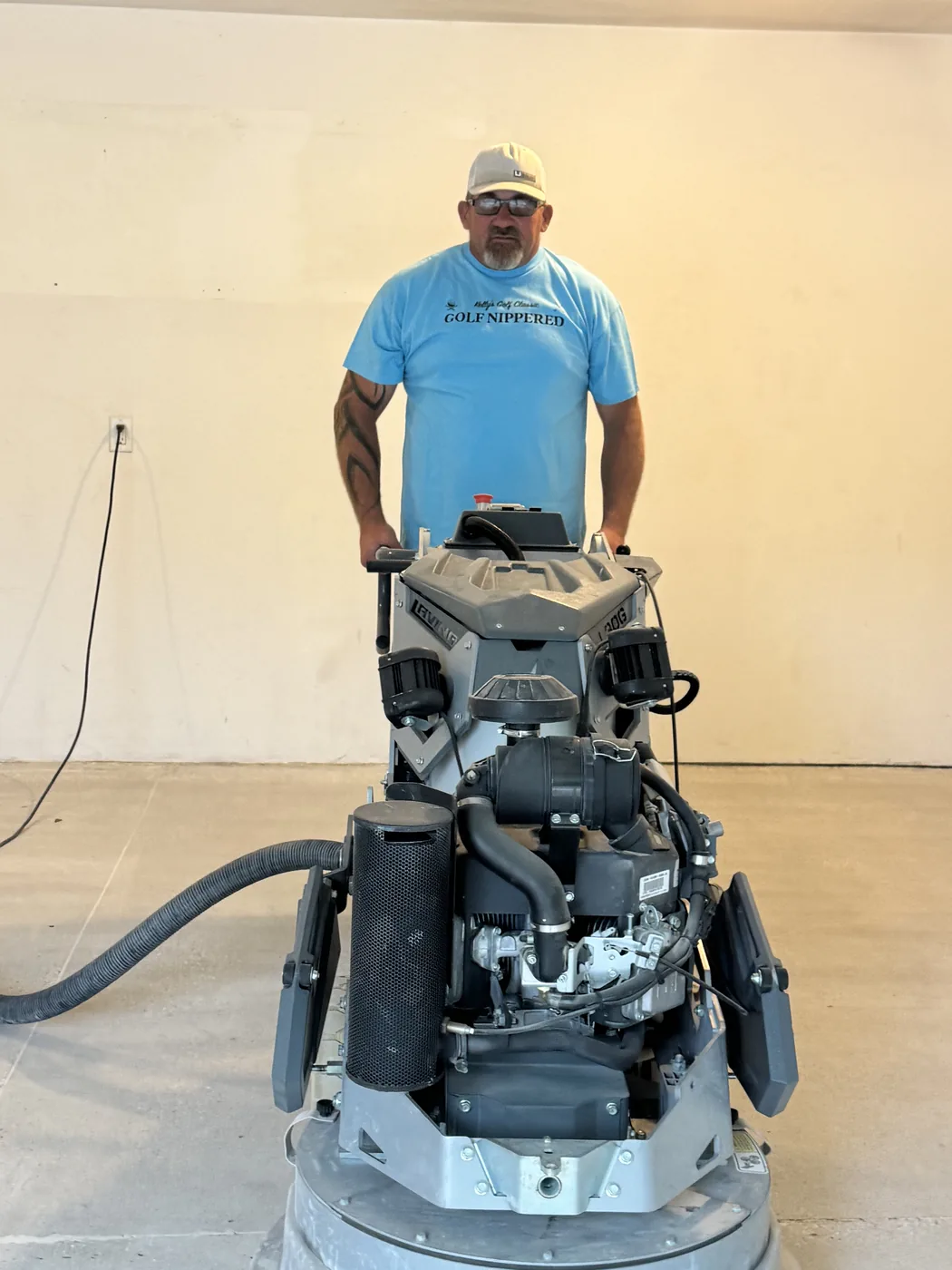
Diamond grinding opens the surface of the concrete mechanically so the coating has something to grab. It's slower, it's dustier, and it's the single biggest reason a floor lasts. Acid etching is faster and cheaper. We don't do it.
We fix what's broken.
Cracks, spalls, pits, and low spots get repaired before coating — not coated over and forgotten.
We build the floor in layers.
Base coat, flake broadcast if you've chosen a flake finish, then the topcoat. Each layer goes on in its own window.
We walk it with you.
When it's done, we go over the floor together, and you get written care instructions so you know how to keep it looking new.
A customer, in her own words
This is the floor in the photographs above.
“My garage floor contained numerous stains including rust, different colors on the floor and some large oil/grease stains.”
“Toby Thompson of Sterling Concrete Coatings explained the garage floor costing process and also provided several color options.”
“The work done by this company far exceeded my expectations. It is a beautiful floor and definitely adds value to my home. I highly recommend this type of upgrade to the home.”
AJ P. · Waukee, Iowa · read it on Google
She bought the house in 2014; it was built in 2004. Two decades of rust, oil and discoloration, ground back to bare concrete and rebuilt in layers. Quoted with her permission.
Epoxy or polyaspartic?
Short version: epoxy is the name everybody knows, polyaspartic is the better product — and the right answer depends on your space, not on which one sounds fancier.
Epoxy builds a thick, hard, inexpensive base layer. It's a workhorse. It also yellows in sunlight and needs warmer temperatures to cure.
Polyaspartic cures fast, handles cold better, holds its color in the sun, and takes hot tire pickup without lifting. It costs more.
Most of our floors use both — epoxy where it does its job, polyaspartic on top where the abuse happens.
If somebody’s telling you one is always the answer, they’re selling what they buy in bulk.
Serving the West Des Moines metro
We're based in Waukee and we work the metro around it.
- Waukee
- West Des Moines
- Clive
- Urbandale
- Grimes
- Johnston
- Windsor Heights
- Des Moines
- Ankeny (outer edge of our area — ask us)
- Central Iowa — call for availability
Contact
Talk to us
You'll be talking to an owner, not a call center.
Good for commercial inquiries, drawings, or anything with detail attached.
tthompson@sterlingconcretecoatings.com →Request an estimate
Tell us about the space and we'll come look at it. Free, and you get the scope in writing.
Request an estimate →Based in Waukee, Iowa. If we don't answer we're on a job — please leave a message or text us, and you'll hear back the same day.
Just built, or just poured?
New concrete is its own conversation. A standard coating system wants 28 days of cure behind it — the manufacturer’s condition of coverage, not ours — because concrete keeps giving off moisture long after it is hard enough to park on.
That does not automatically mean waiting. There is a system built for green concrete, and choosing it is a decision made at the estimate rather than a delay handed to you halfway through a build.
If your house, garage or shop went up this year, say so when you call. It changes what we specify, and it is much cheaper to know now than to find out from a floor that lets go.
Questions we get a lot
How long does it take?
Most residential garages are a two-day job. Day one is prep and base coat, day two is topcoat. You'll have specific timing in your written scope — including when you can walk on it and when you can park on it.
Will it hold up to Iowa winters?
Yes — and the honest answer is that winter isn't what kills coatings. Salt and freeze-thaw find weak spots, but they only find them if the bond was bad to begin with. That comes back to prep.
Can you do it in the winter?
Interior heated spaces — basements, finished shops, most commercial floors — year-round. Unheated garages need warmer weather, roughly April through October, though polyaspartic stretches that window on both ends.
Do I have to empty the garage?
Yes, completely. We'll tell you exactly when, and how long it needs to stay empty.
Do you do repairs on somebody else's failed coating?
Sometimes. It depends on how much of the old system is still bonded. We'll tell you honestly if a tear-out is the better spend — including if that means we're not the cheapest call you make.